Toodyloo - AI-Powered To-Do App Built Because Wunderlist Is Gone
I built Toodyloo because I missed Wunderlist. It is a full-stack portfolio app with AI-powered task and list creation, optimistic UI, and a production-grade architecture built on TanStack Start, OpenAI, and Neon PostgreSQL.
 View Source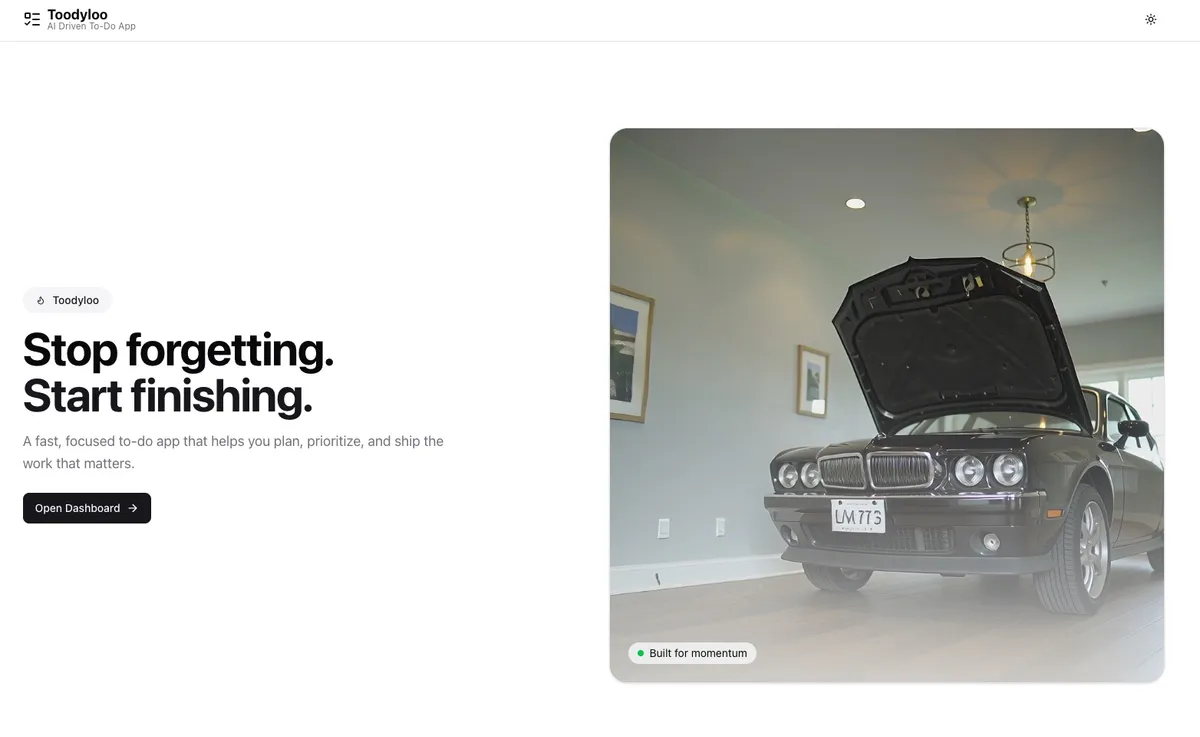
Wunderlist was the best task app ever made. Microsoft acquired it, shut it down in 2020, and replaced it with Microsoft To Do. Nothing quite filled that gap.
So I built Toodyloo. It is a full-stack portfolio project that combines the clean, focused task management I loved in Wunderlist with real AI features powered by OpenAI. You can describe a goal in plain English and the AI generates an entire list or a set of structured tasks for you. The whole app was built with AI assistance, from architecture planning to production deployment.
Why I Built This
I have been a Wunderlist fan since 2013. The app was fast, clear, and never got in the way. When it was shut down, I tried every replacement, and none of them felt right.
Building my own was the obvious next step. It gave me the chance to use a stack I was genuinely excited about, ship a real product I would actually use, and demonstrate full-stack React skills across every layer of the application.
Toodyloo is my portfolio project. It is not a toy. The code is production-grade, the app is deployed on Netlify with server-side rendering, and everything from the database to the UI is fully type-safe.
Overview
Toodyloo shows how to build a modern full-stack application with real AI integration baked in from the start, not added as an afterthought.
- AI-Powered List Creation: Describe a project or goal and OpenAI generates a complete, structured list for you
- AI Task Generation: Create individual tasks from a single plain-English prompt, with priorities and due dates filled in automatically
- Optimistic UI: Every action updates the screen instantly before the server responds
- Type Safety: Types flow from the Drizzle schema through server functions to React components without any gaps
- Authentication: Secure email/password accounts with Better Auth
- Observability: Sentry integration for error tracking and performance monitoring
- Anonymous Mode: Try the app without signing up first
Technical Breakdown
Tech stack: TanStack Start, React 19, TypeScript, PostgreSQL, Drizzle ORM, Better Auth, OpenAI, Sentry, shadcn/ui, Tailwind CSS v4, Zod, TanStack Query, Netlify.
- Built the full-stack application with TanStack Start for server-side rendering and type-safe server functions
- Used TanStack Router for file-based, fully type-safe routing
- Connected to a Neon PostgreSQL database using Drizzle ORM for type-safe queries and migrations
- Implemented Better Auth for email/password authentication with anonymous session support
- Integrated OpenAI in the backend so users can generate lists and tasks from plain-English prompts
- Instrumented server functions with Sentry spans for error tracking and performance monitoring
- Built UI components with shadcn/ui and Radix UI for accessible, consistent design
- Styled with Tailwind CSS v4 for responsive, modern layouts
- Used Zod for runtime validation that doubles as the source of truth for TypeScript types
- Managed server state with TanStack Query including optimistic mutations and automatic cache invalidation
- Deployed on Netlify with SSR and serverless functions via the official TanStack Start adapter
Key Features
- AI List Generation: Tell the AI what you are working on and it builds a complete, organized list
- AI Task Creation: Describe a task in plain English and the AI extracts the title, priority, and due date automatically
- AI Subtask Breakdown: The AI reads a task and suggests logical subtasks, turning big goals into manageable steps
- Smart Task Management: Organize tasks into lists with color-coded categories and subtask hierarchies
- Optimistic Updates: Instant UI feedback with automatic rollback on errors
- Activity Log: Real-time progress indicators and a full history of all operations
- Advanced Filtering: Filter by status, priority, due date, and category
- Responsive Design: Works on desktop and mobile
- Dark Mode: System-aware theme switching
- Anonymous Mode: Use the app locally without an account, then sign up to save your data
Technical Highlights
Type-Safe Architecture
Types start at the Drizzle schema, flow through Zod-validated server functions, and land in React components without a single any. A schema change produces TypeScript errors across the entire codebase instantly, which catches bugs at compile time instead of in production.
Optimistic UI Pattern
Every mutation updates the UI before the server responds. If the request fails, the change rolls back automatically with a user-friendly error message. A global activity drawer shows a live log of all pending and completed operations. This pattern makes the app feel as fast as a native application.
AI Integration with OpenAI
The AI features connect to OpenAI’s API in a TanStack Start server function. The user’s prompt is sent to gpt-4o-mini, the response is parsed and validated with Zod, and the results are saved directly to the user’s account. Fast, structured, and type-safe from prompt to database.
Production Observability
Every server function is wrapped in a Sentry.startSpan() call. This gives structured traces for every database query and AI call, which makes debugging and performance tuning straightforward.
Why I Chose TanStack Start Over Next.js
I have built a lot of production React, and I have strong opinions about frameworks. I want clarity, type-safety, and control. Next.js App Router is powerful, but the modern model asks you to internalize a lot of implicit behavior around caching, where code runs, and how Server Components interact with Client Components. I got tired of fighting it.
Here is why I chose TanStack Start for this project:
1. No RSC mental gymnastics as the default I do not want to constantly ask “server component or client component?” TanStack Start keeps boundaries explicit and easy to reason about.
2. Server Functions are the right abstraction
I want backend logic colocated with my app, but explicit and easy to test. TanStack Start’s createServerFn is a clean abstraction for full-stack work without turning every mutation into framework ceremony.
3. Type-safe routing is not optional TanStack Router makes route params and navigation fail at compile time instead of in production. Stringly-typed routes make refactoring scary.
4. The data layer is predictable TanStack Query’s primitives for caching, invalidation, optimistic updates, and retries fit TanStack Start’s mental model cleanly. App behavior stays consistent and debugging is straightforward.
5. Platform portability I deploy where it makes sense. This app runs on Netlify with SSR and server functions via the official framework adapter.
Next.js still has its place. But for this project, I wanted a system that stays understandable as it grows.
Obstacles and Solutions
Obstacle: Optimistic UI with Error Handling
Users expect instant feedback, but network requests can fail. Building optimistic updates that handle errors gracefully required a system that could track every pending operation and recover cleanly.
Solution
I built a global optimistic operations provider that:
- Tracks all pending operations with unique IDs
- Shows real-time progress indicators in a drawer
- Automatically rolls back failed operations with user-friendly error messages
- Logs all operations to an activity history
TanStack Query mutations with onMutate callbacks handle the client-side state. Sentry captures any failures for later review.
Obstacle: End-to-End Type Safety
Maintaining types from the database schema through server functions to the UI is important but requires discipline, especially when queries are dynamic.
Solution
The type flow works like this: Drizzle schema defines the tables, createSelectSchema() turns those into Zod schemas, z.infer<> produces the TypeScript types, and those types are used everywhere. A change in the database schema automatically produces type errors in server functions and UI components. Bugs surface at compile time.
Obstacle: AI Integration with Privacy in Mind
Adding AI features while being clear about data handling required careful UX decisions and server-side guardrails.
Solution
I added clear privacy notices in the AI dialog explaining that prompts are sent to OpenAI. Users see links to the Privacy Policy and Terms of Service before using AI features. On the server side, prompts are never logged beyond what Sentry needs for error tracing, and AI calls run through validated server functions so no raw input reaches the database.
Author
Aaron Molina - Senior Frontend Developer
Credits
Project Details
Quick facts- Completion Date
- January 2025
- Project URL
- https://toodyloo.netlify.app/
- Technologies
- React.js TypeScript tanstack-start tanstack-router PostgreSQL drizzle-orm better-auth OpenAI sentry netlify shadcn tailwind zod react-query optimistic-ui Fullstack